

Are you looking for a way to introduce your elementary music students to the wonder and magic of Baroque music? Look no further than Vivaldi's Spring. This timeless masterpiece is not only beautiful, but it's also an excellent tool for teaching young students about program music and mood in music.
More about the Work
Antonio Vivaldi's Spring is a beautiful and iconic violin concerto that forms part of his larger work, "The Four Seasons." The piece is a notable example of program music, which is a form of music that attempts to tell a story or evoke a specific image or emotion in the listener's mind.
A perfect introduction to Baroque music for students, it highlights many of the genre's signature features, such as virtuosic solo passages, elaborate ornamentation, and the use of contrast and variation to create dynamic musical forms.
In addition to the musical concerto, it's worth noting that Spring also has a corresponding sonnet that Vivaldi wrote himself. Your students may be delighted to find that the sonnet contains descriptive text that matches the music quite well! This serves as an example of programmatic music in poetry. The connection between music and poetry adds a layer of depth and meaning to the piece and can provide an interesting topic for discussion and a jumping-off point for creativity in the music classroom. Here's the sonata:
A perfect introduction to Baroque music for students, it highlights many of the genre's signature features, such as virtuosic solo passages, elaborate ornamentation, and the use of contrast and variation to create dynamic musical forms.
In addition to the musical concerto, it's worth noting that Spring also has a corresponding sonnet that Vivaldi wrote himself. Your students may be delighted to find that the sonnet contains descriptive text that matches the music quite well! This serves as an example of programmatic music in poetry. The connection between music and poetry adds a layer of depth and meaning to the piece and can provide an interesting topic for discussion and a jumping-off point for creativity in the music classroom. Here's the sonata:
Spring by Antonio Vivaldi
Allegro
Springtime is upon us.
The birds celebrate her return with festive song,
and murmuring streams are softly caressed by the breezes.
Thunderstorms, those heralds of Spring, roar, casting their dark mantle over heaven,
Then they die away to silence, and the birds take up their charming songs once more.
Largo
On the flower-strewn meadow, with leafy branches rustling overhead, the goat-herd sleeps, his faithful dog beside him.
Allegro
Led by the festive sound of rustic bagpipes, nymphs and shepherds lightly dance beneath the brilliant canopy of spring.
Breaking it down for your student

Upper elementary students love learning Italian vocabulary! Some of the terms that you may wish to introduce are:
- Ritornello: means "returning" and usually indicates a short, recurring instrumental passage, particularly a tutti section. Both of the allegro movements use this form.
- Tutti: all instruments play together
- Solo: passage played by a single performer
- Mood: the emotional effects on the listener, the atmosphere of the piece
Younger students will enjoy listening for the happy springtime dance represented by the ritornello, as well as the songs of the birds, the blowing breeze & flowing stream, and the thunderstorm in the first movement.
Encourage Student Creativity

Listen & Move
Guide your students to create their own choreography to accompany the music. This not only gets them moving and active but also encourages them to think creatively and expressively. They can use movements and gestures to represent the different elements of spring, such as flowers blooming, birds chirping, and rain falling. Props such as scarves & ribbon wands are the perfect addition to these movement activities.
Does the idea of movement scare you because you are not a dancer? Actually, neither am I. The thought of the behavior management challenges often made me think twice about movement. However, over time did come to understand that our students need to move. Many times, seated movements of hands, arms, heads, and spines are perfect for a particular group. Don't be afraid to experiment with movement by starting slow and starting low - from a seated position!
Listen & Draw
Because Vivaldi's Spring is program music, this makes it a perfect inspiration for student drawings to represent the mood. As you introduce this drawing activity, consider that student artwork does not have to be realistic images of a springtime scene. In fact, a more abstract drawing using colors and shapes may give students more freedom to express their feelings on paper and minimize the frustration and frequency of the "I can't draw a bird" comments. The different interpretations of how the sound makes students feel will delight you.
Expand Creativity with Classroom Instruments

First, of course, is to have firmly established rules for handling classroom instruments. Include explicit instruction on how to play them "like the professional musicians do." In addition, teach your students a rest position so they know what to do with the instrument when it isn't their turn to play.
Next, consider which instruments will make the best contribution to the theme of spring and the Baroque style of music. I didn't get out any big drums for this piece! 😁
Instead, I chose rhythm sticks and jingle taps to play a steady beat on the ritornello section. Students chose instruments to represent the birds, the breeze & brook, and the thunderstorm. Egg shakers, cabasa, triangles, jingle bells, wood block, guiro, rainstick, and wind chimes were usually available for selection. I didn't have an ocean drum, but I might have considered adding this one to represent the water and the thunder. The conductor-either the teacher or a student-should direct the groups of instruments to play at their turn.
Finally, a discussion of the dynamics of the piece will serve you well. Help students notice the changing dynamics and label them with appropriate music terms. Encourage students to match their instrument playing to the dynamics of the professional performance.
Create a Soundscape-Add Poetry
In addition to (or instead of) adding instruments to Vivaldi's music, consider using those instruments to create a spring soundscape. Use Vivaldi's sonnet above or challenge your students to write their own lyrics or poetry inspired by Vivaldi's sonnet & music. This will allow them to explore the themes of the piece in a more personal and creative way. They can use their own experiences and emotions to craft a unique perspective on spring, and then perform their original work for the class.
Resources for implementation
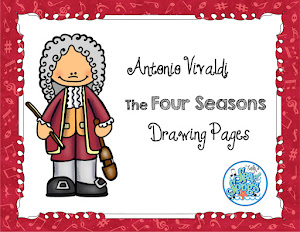
If I was teaching this lesson myself, when it came time to draw to the music I would pass out blank pieces of paper and a small number of crayons for each student. However, if I were leaving the drawing lesson for a sub, I might want a little more direction for that guest teacher. I have created some coloring sheets, that may serve this purpose for you as well. You can find them in the free resource library on the Members Page of this blog. (To learn the password, please complete the signup form at the bottom of this page!)
Wakelet Collections
The two Wakelet collections linked below may help you to organize your video resources. The first one is a collection of performances, play-alongs, and movement activities. The second one is what I would use as an actual sub plan. When I include Wakelet collections in sub plans, I always print out a page with general classroom instructions, directions for turning on the computer/projector/speakers, and the SHARE link to the Wakelet collection. It was always helpful to email the plan to an administrator or directly to the sub so they could simply click on the link.
Vivaldi's Spring - Video Performance Collection
Vivaldi's Spring - Music Sub Plan
Finale
By incorporating a variety of listening & creating activities, you're giving your students a more dynamic and memorable learning experience. They'll be able to connect with the music on a deeper level and develop their musical skills in the process. As you unlock the magic of this piece, your students will discover the beauty of music and develop a lifelong love for it.Musically yours,

.jpeg)
.jpeg)
.png)
.png)
.png)
.png)



.png)